
Loading insight...
Loading insight...
Guide with a comparative table of Freelancers, Traditional BPO and Xternus for efficient outsourcing and strategic control.
Outsourcing projects has a direct impact on your company’s digital transformation, process optimization and corporate strategy. Not all options offer the same level of control, scalability and strategic outcomes.
In this comparison we analyze three key alternatives (freelancers, traditional BPOs and Xternus) to help you make informed decisions.
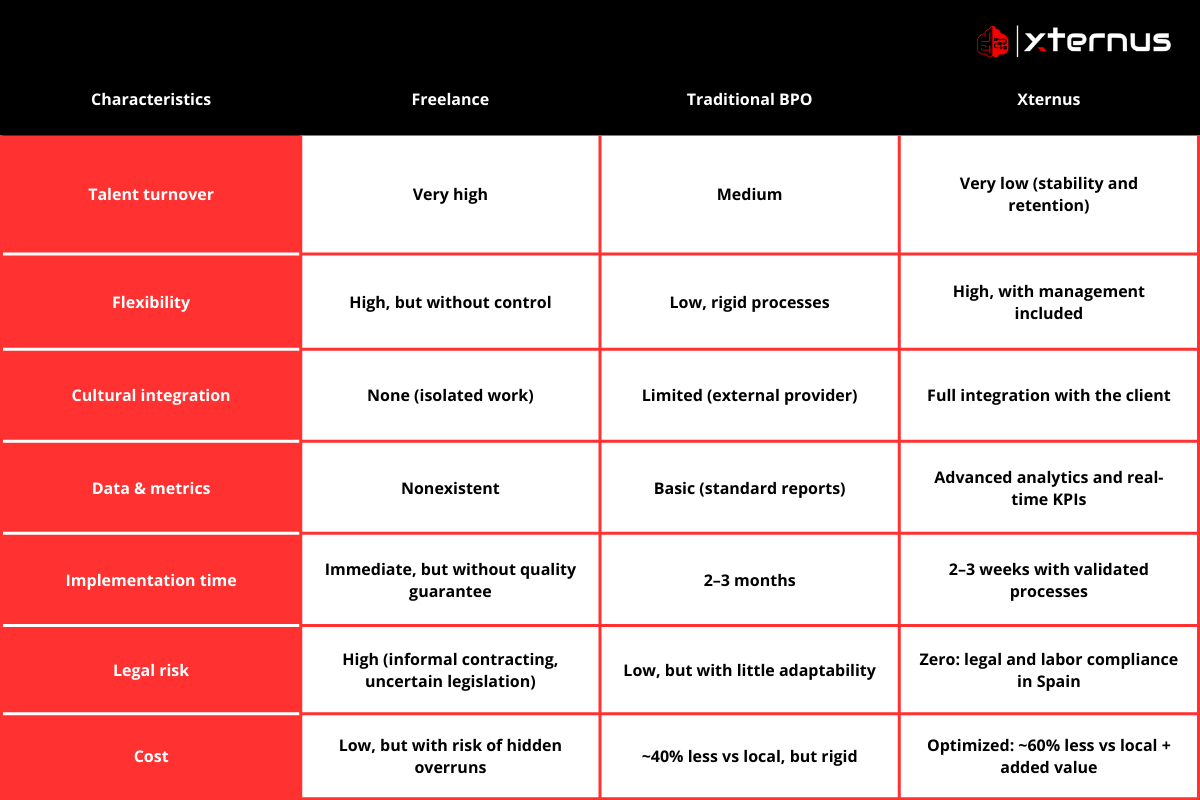
In the case of freelancers, turnover is very high. Availability is limited and the lack of long-term commitment usually generates inconsistencies in delivery.
Traditional BPOs offer medium turnover, with some operational stability but a lower level of specialization.
By contrast, Xternus ensures very low turnover, thanks to a model that promotes retention of specialized talent and guarantees continuity in every project.
Freelancers allow high flexibility, but they lack control and strategic alignment with the company’s objectives.
Traditional BPOs tend to be poorly adaptable, as they operate with rigid, standardized processes.
Xternus combines flexibility with included management, offering teams that adjust to the client’s needs and provide support in strategic projects, Design Thinking methodologies, Growth Enablement and automation.
Freelancers work in isolation, without connection to the company’s culture or internal processes.
With traditional BPOs, cultural integration is limited, as they are perceived as an external provider without deep alignment.
Meanwhile, Xternus offers full integration, acting as an extension of the client’s team and aligning its capabilities with corporate strategy, digital transformation, AI application and process optimization.
With freelancers, there is practically no data management or performance measurement, which makes evidence-based decision making difficult.
Traditional BPOs offer basic metrics, generally through standard reports.
In contrast, Xternus provides advanced analytics with business intelligence dashboards, performance metrics and automated real-time reports, enabling precise and strategic management.
Freelancers can be onboarded immediately, although lack of consistency compromises long-term quality.
Traditional BPOs require between two and three months to deploy a project, which makes them slower for strategic initiatives.
Xternus manages to implement teams in just two to three weeks, thanks to validated and scalable processes that operate in key sectors such as insurance, logistics, healthcare, retail, energy, education and technology.
Hiring freelancers involves high legal risk due to informal contracting and legal uncertainty.
Traditional BPOs partially reduce that risk, but show limitations in adapting to regulatory changes.
Xternus eliminates legal risk, guaranteeing legal and labor compliance in Spain, with additional protocols in corporate ethics and compliance in the use of artificial intelligence.
The freelance model is usually attractive due to its low costs, although hidden overruns often appear and impact the budget.
Traditional BPOs allow a reduction of around 40% compared to local teams, although they sacrifice flexibility and scalability.
With Xternus, cost is optimized: investment is reduced by up to 60% versus local hiring, while adding value in quality, strategic results and scalability.
When it comes to strategic outsourcing, freelancers are useful for one-off projects or specific tasks that do not require complex coordination or deep integration with internal processes. Traditional BPOs, for their part, are suitable for repetitive operations with stable volume, offering some stability but little flexibility and customization.
Xternus, on the other hand, offers the perfect balance between specialized talent, agility, cultural integration and strategic control. Our proposal combines experience in Technology Modernization, Change Management, Process Optimization, Business Intelligence and Growth Enablement, enabling your company to scale operations efficiently, optimize resources and obtain measurable results, all while maintaining full alignment with your corporate strategy and digital transformation objectives.
Freelancers are ideal for one-off tasks or specific projects that don’t require deep integration with your internal processes. A traditional BPO is better for repetitive, high-volume operations but offers less flexibility. Xternus combines the best of both worlds with on-demand flexible teams, full cultural integration and strategic management.
Xternus brings agility, retention of specialized talent and advanced analytics. Unlike traditional BPOs, our teams fully integrate with your culture and processes, delivering measurable results through KPIs and Business Intelligence dashboards, process optimization and strategic growth.
Each Xternus team joins as an extension of your company, fully aligned with your corporate strategy, digital transformation objectives and internal culture. We use validated methodologies in Design Thinking, Growth Enablement and Process Optimization to ensure maximum collaboration and consistent results.
How long does it take to implement a flexible Xternus team?
Full implementation of a flexible team with Xternus typically takes 2–3 weeks, depending on scope and industry. This is significantly faster than a traditional BPO (2–3 months), allowing you to start generating measurable results from the outset.
Xternus provides real-time dashboards, automated reports and advanced analytics. You can monitor key metrics for operational efficiency, productivity and strategic compliance, enabling quick decisions and continuous improvement of outsourced processes.
Freelancers can introduce legal risk due to informal contracting; traditional BPOs have limited adaptability to regulatory changes. Xternus ensures legal and labor compliance in Spain, including AI regulation and professional ethics, eliminating risks and ensuring safe, scalable operations.
View related insights
View related insights
View related insights
View related insights
View related insights
View related insights
View related insights
View related insights
View related insights
View related insights
View related insights
View related insights
Learn to automate outsourced processes with AI and flexible talent without losing the human touch.
Read More →Adapting to change is a strategic necessity, not just a survival tactic. In this article, Xternus shares practical business adaptation strategies to help Spanish SMEs build resilience, boost operational agility, and stay competitive in evolving markets.
Read More →Assess your brokerage’s readiness for a DANA and improve its operational resilience for a better response capacity.
Read More →Discover how the most efficient COOs turn operational complexity into measurable growth.
Read More →Avoid bottlenecks in insurance with automation and flexible teams for faster and more efficient processes.
Read More →Identify which administrative tasks to outsource and free your team to focus on strategy and growth.
Read More →